
Restoration of the aquatic–terrestrial ecological corridor in the Bièvre plain
Bièvre Liers Environnement
Bossieu, Saint Hilaire de la Côte
9 000€
-
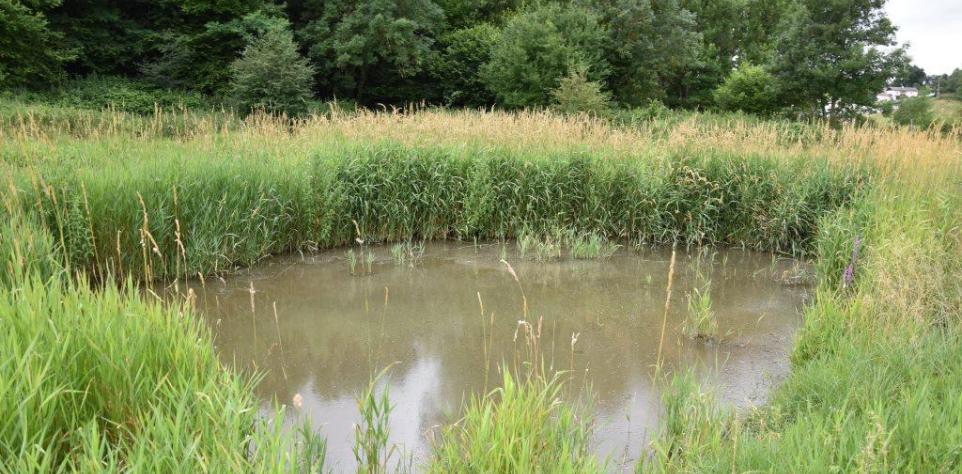
Creation of new ponds, serving as transition zones between aquatic and terrestrial environments.
Titre
Bièvre Liers Environnement
Paragraphe
Bièvre Liers Environnement is a local association committed to environmental protection in the Bièvre Isère intermunicipal area and its surroundings. It brings together just over 100 members and around fifteen volunteers. Its activities cover several areas, including environmental education, ecological monitoring, participation in the development of local public policies, and environmental conservation.
Titre
Strengthen the network of ponds
Paragraphe
In the Bièvre and Liers plains, natural environments are highly fragmented by agriculture and urban development (business and industrial zones). These plains are bordered by more forested areas, such as the Bonnevaux and Chambaran massifs, but ecological connectivity between these zones remains limited.
In this context, the aquatic–terrestrial ecological corridor plays a key role: it refers to transition areas between aquatic and terrestrial environments (ponds, hedgerows, wetlands, etc.), which are essential for many species.
These areas allow species to move, reproduce, and feed. Their degradation therefore directly weakens local biodiversity. Restoring and preserving these ecological connections is thus a key challenge for maintaining functional ecosystems in the area.
Between 2023 and 2025, Bièvre Liers Environnement carried out an initial project to restore the aquatic–terrestrial ecological corridor in the Bièvre plain. Following an inventory conducted across eight municipalities, 10 ponds were created and 3 restored.
Paragraphe
The new project supported by the Sidas World Foundation aims to:
- Continue this inventory work, particularly in hillside and forested areas,
- Strengthen the network of ponds in priority areas such as the Banchet hill and the southern part of the Bonnevaux region.
The objective is to create between 12 and 20 new ponds, while improving ecological connectivity, in particular through the planting or restoration of hedgerows.
These actions address a major issue: small wetlands are essential to the life cycle of amphibians, particularly certain species that are currently threatened, such as the palmate newt, the alpine newt, brown and green frogs, and the great crested newt, the most vulnerable species. By facilitating their movement between nearby habitats, the project helps maintain viable populations in the area.
It is being implemented in partnership with several organisations specialising in nature conservation.